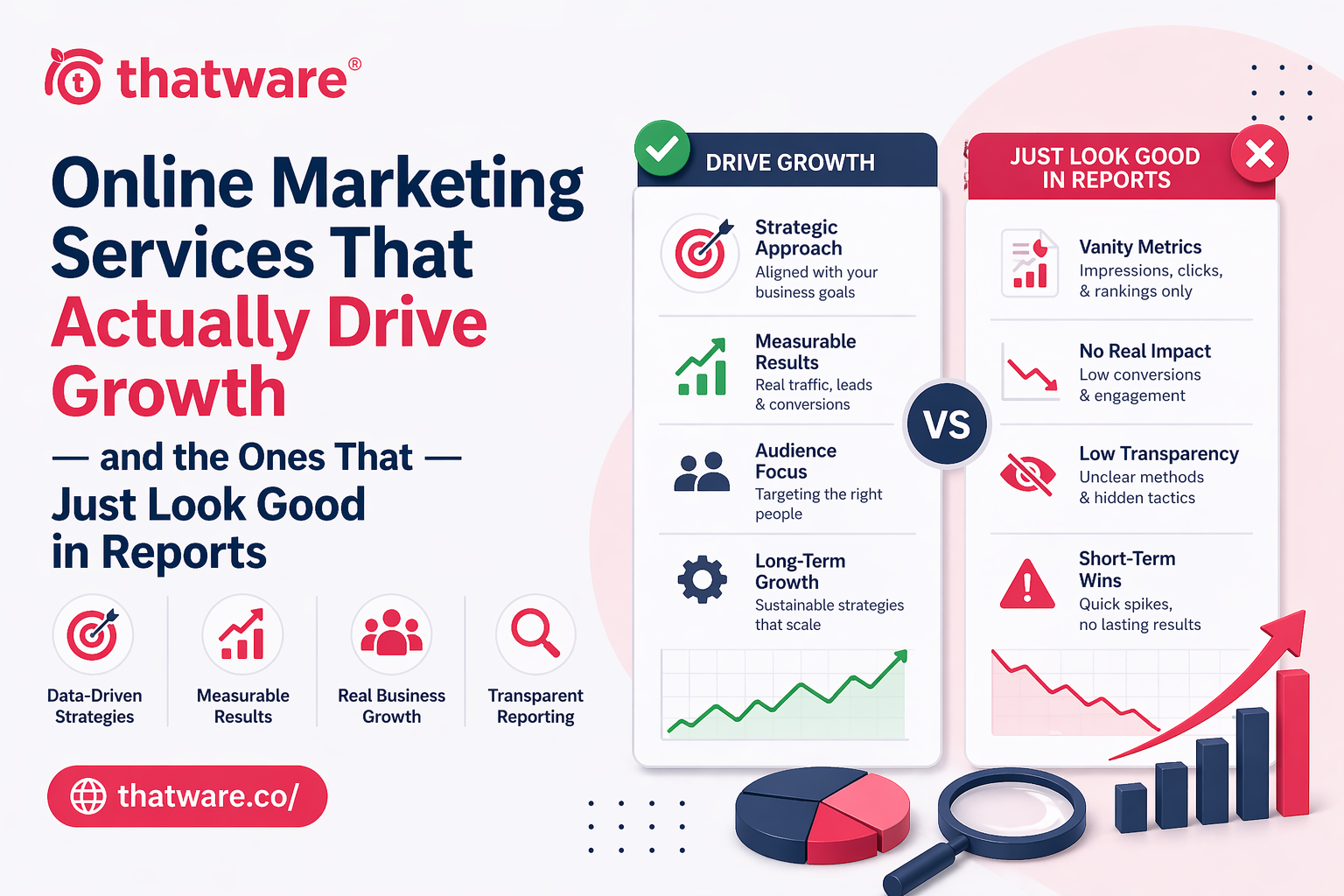
There’s a specific kind of marketing report that looks impressive in a meeting and means very little for your business. High impressions. Strong CTR. Growing follower count. Engagement up 22% month-over-month. None of these numbers are necessarily connected to the thing that actually matters: are more people buying from you?
The online marketing services landscape is full of ways to spend money on metrics that feel like progress. Some of it is intentional – not every agency is optimizing for your outcomes rather than their own retention. But a lot of it is just drift: it’s easier to measure reach than impact, so reach becomes the proxy for success even when the correlation to actual business outcomes is weak.
The services that actually drive growth share a common characteristic: you can draw a reasonably direct line from the activity to a revenue outcome. Everything else is either in service of that line or it isn’t.
The Channels That Drive Revenue and the Ones That Support It
Not all marketing channels have the same relationship to direct revenue generation, and confusing them is how budgets get misallocated.
Search – both paid and organic – tends to have the most direct path to purchase, because it captures people actively looking for something. When someone searches for “accountant for startups London” or “buy noise-cancelling headphones,” they’re declaring intent. Marketing that intercepts declared intent converts better than almost anything else, which is why search budgets tend to have strong, measurable ROI when managed well.
Email has a similarly strong revenue relationship for businesses with existing customer relationships. For e-commerce, email consistently outperforms almost every other channel on revenue-per-engagement metrics. It’s not flashy, which is probably why it’s often underfunded relative to its actual contribution.
Content marketing and organic social have a different relationship to revenue – they build the brand trust, authority, and audience familiarity that make other channels more effective. The conversion path is longer and harder to attribute directly. That doesn’t make them less important; it makes them harder to justify in a short-term ROI framework. Brands that understand this invest in them strategically. Brands that don’t understand it either cut them during budget crunches or keep them running without connecting them to any business objective.
Paid social has a more complicated story. It can drive direct response when targeting is precise and creative is strong. It can build brand awareness at scale. It can also consume significant budget generating engagement metrics that have no downstream business impact. The difference is usually in how carefully objectives are defined and how rigorously outcomes are measured.
What “Digital Marketing Services” Often Bundles That Isn’t Worth Buying
Agencies selling bundled digital marketing packages often include services that add cost without proportionate value for most businesses.
Generic display advertising – banner ads on content networks – has very low conversion rates for most businesses and works primarily for brand awareness at significant scale. For most SMBs, it’s a budget drain.
Social media management – posting on behalf of the brand – is worth something if done with genuine strategic intent and quality content. It’s worth almost nothing if it’s filling a content calendar with generic posts designed to maintain the appearance of activity.
Press release distribution – not real PR, but mass press release syndication services – is largely worthless for SEO (the links produced are typically no-follow or low quality) and typically doesn’t result in actual media coverage.
The common thread here isn’t that these activities can never work – it’s that they’re often included in packages not because they’re the right fit for a given business, but because they’re cheap to provide and give the appearance of comprehensive service.
How to Evaluate Digital Marketing ROI Honestly
A simple framework for evaluating any online marketing service: can you trace a clear path from this activity to customer acquisition or retention? If yes, what does that path look like and how long does it take? What’s the cost per customer acquired through this channel versus your alternatives?
Most online marketing services worth paying for can answer these questions honestly – maybe not with perfect precision, because marketing attribution is always somewhat imperfect, but with enough rigor to make resource allocation decisions with confidence.
Services that respond to these questions with vague appeals to brand building, awareness, or “long-term value” without any connecting logic to revenue outcomes deserve scrutiny. Not dismissal – some of those investments are genuinely important. But scrutiny.
The Integration Question
One of the most significant factors in whether digital marketing drives growth or just activity is whether channels are working together.
Search and content reinforce each other. SEO-driven content builds organic authority; paid search converts the demand that organic builds. Email and social support each other’s audience development. PR coverage builds the authority signals that make SEO more effective.
When these channels are planned in coordination – with shared messaging, aligned audience understanding, and consistent measurement – they produce compounding returns. When they’re managed in silos, each channel is essentially starting over rather than building on what others have established.
Internet marketing company options worth considering are the ones that demonstrate genuine cross-channel thinking – that understand how their different service offerings interact and can articulate a coherent growth strategy rather than a menu of services.
Asking the Right Questions Before You Commit
Before engaging any online marketing service, a few questions consistently reveal whether you’re likely to be dealing with a genuine growth partner or an agency optimizing for contract renewal.
What metrics will you use to measure success, and how are those connected to my actual business objectives? The answer should be specific and commercially grounded.
What would “failure” look like, and what would you do differently? Agencies that have never thought about failure are not thinking carefully about your outcomes.
What are you NOT going to do for us, and why? This reveals values and judgment. An agency willing to tell you which services or tactics wouldn’t serve your specific situation is showing you they’re thinking about fit rather than scope maximization.
What have you done for clients in similar situations to ours, and what happened? Not the best possible case study – a representative one. The answer tells you about typical outcomes rather than exceptional ones.
Online marketing can drive genuine, compounding growth. The agencies that help clients achieve it aren’t necessarily the flashiest or the largest. They’re the ones who understand your specific business context, make clear-eyed resource allocation recommendations, and measure their success by your outcomes rather than their own metrics. Finding them requires asking the right questions.